


 Local culture
Madrid serves as a grand proof of Spain’s historical evolution. It possesses a cultural depth that easily rivals any European capital. Travelers who want more than basic sightseeing should dive into the city’s living legacy, which spans centuries of artistic triumphs and neighborhood customs.
To experience this lively capital, visitors should look beyond the standard tourist spots. They must actively seek to Discover Madrid’s Local Culture, Traditions, Arts and Heritage. This guide outlines the cultural coordinates, historical landmarks, and daily rituals that define the true Madrileño identity today.
| Cultural Pillar | Key Highlight | Must-Visit Location |
|---|---|---|
| Fine Arts | The Golden Triangle of Art | The Prado Museum |
| Local Festivities | Fiesta de San Isidro & Verbenas | Pradera de San Isidro & La Latina |
| Gastronomy | Historic Taverns & Tapas Crawls | Sobrino de Botín |
| Performing Arts | Flamenco & Zarzuela Opera | Corral de la Morería |
The Golden Triangle of Art
The Paseo del Prado houses three of the most prestigious art institutions on earth. People know this area as the Golden Triangle of Art. The Prado Museum alone displays over 8,600 paintings and over 1,000 sculptures, focusing heavily on European masters from the 12th to the 19th centuries.
Visitors can study works by Diego Velázquez, Francisco de Goya, and Hieronymus Bosch in a single afternoon. Nearby, the Reina Sofía National Art Museum shifts the focus to modern and contemporary masterpieces.
This museum holds Pablo Picasso’s grand anti-war painting Guernica. It also features extensive collections of Salvador Dalí and Joan Miró. Art lovers can track the whole path of Spanish visual culture by walking a mere 1.
2 kilometers along this leafy boulevard.
The Thyssen-Bornemisza Museum completes the triangle. It bridges historical gaps with an extraordinary private collection that offers a chronological journey from Italian Gothic works to 20th-century Pop Art. This dense cluster of top-tier museums makes the neighborhood a prime center for artistic education.
- The Prado Museum: Home to Velázquez’s Las Meninas and Goya’s Black Paintings.
- Reina Sofía: The premier destination for 20th-century Spanish masterpieces and avant-garde installations.
- Thyssen-Bornemisza: A vast survey of European art spanning eight centuries of history.
Traditional Festivities and Street Celebrations
Madrid’s annual calendar is punctuated by lively street festivals that date back to the Middle Ages. The most significant of these is the Fiesta de San Isidro. This event takes place every May to honor the patron saint of the city.
During this festival, locals dress in traditional chulapo and chulapa attire. They gather in the Pradera de San Isidro to dance the chotis. This traditional dance requires the male partner to spin on a single tile while his partner guides him.
In August, the historic neighborhoods of La Latina, Lavapiés, and Chamberí host consecutive street festivals known as verbenas. The Verbena de la Paloma is the largest one. It transforms public squares into open-air dance floors adorned with colorful paper lanterns.
Participating in these street events is one of the best ways to Discover Madrid’s Local Culture, Traditions, Arts and Heritage. These events remain highly popular among younger generations. This keeps historic customs alive in a modern urban environment.
Visitors can sample traditional foods like rosquillas tontas y listas. These are anise-flavored donuts prepared specifically for these spring holidays.
Culinary Heritage and Historic Taverns
The culinary identity of Spain’s capital is deeply linked with its historic taverns. Some of these locations have operated continuously for centuries. Sobrino de Botín, founded in 1725, holds the Guinness World Record as the oldest active restaurant in the world.
This establishment still roasts suckling pigs in its original cast-iron, wood-fired oven. It uses centuries-old techniques to prepare the food. Traditional Madrileño cuisine focuses on hearty dishes designed to sustain workers during cold winters.
The most famous dish is cocido madrileño. This is a rich, three-course stew made from chickpeas, vegetables, and various meats. Restaurants serve this meal in separate stages, beginning with the broth, moving to the vegetables, and concluding with the meats.
Exploring these culinary institutions allows food lovers to Discover Madrid’s Local Culture, Traditions, Arts and Heritage through taste. The practice of moving from bar to bar to sample small plates fosters a highly social atmosphere. It keeps the community connected.
Historic taverns near the Plaza Mayor serve specialty dishes like bocadillo de calamares. This is a simple sandwich of fried squid. It remains a beloved local staple.
- Cocido Madrileño: A slow-cooked chickpea and pork stew served in three distinct courses.
- Callos a la Madrileña: A traditional tripe dish seasoned with chorizo, jamón, and smoked paprika.
- Churros con Chocolate: Crispy fried dough pastry paired with thick, rich hot chocolate.
Historic Neighborhoods and Local Life
Each district in Madrid possesses a distinct personality shaped by historical migration patterns and social classes. The Barrio de las Letras, or Literary Quarter, was the home of Spanish Golden Age writers like Miguel de Cervantes and Lope de Vega.
Today, their quotes are written in golden letters directly onto the pedestrianized cobblestone streets. In contrast, Lavapiés represents the multicultural heart of the city. Here, historic 17th-century tenement buildings stand alongside international markets.
This neighborhood showcases how modern migration patterns build upon the traditional urban fabric. Visitors can explore local street art initiatives that decorate historic brick walls throughout the district.
La Latina offers a maze of narrow medieval streets that follow the old defensive walls of the city. On Sundays, this area hosts the El Rastro flea market. This market has operated since the middle of the 18th century.
Wandering through these diverse districts makes it easy to Discover Madrid’s Local Culture, Traditions, Arts and Heritage at your own pace. You can browse antique stalls and vintage books along the way.
Performing Arts and the Soul of Flamenco
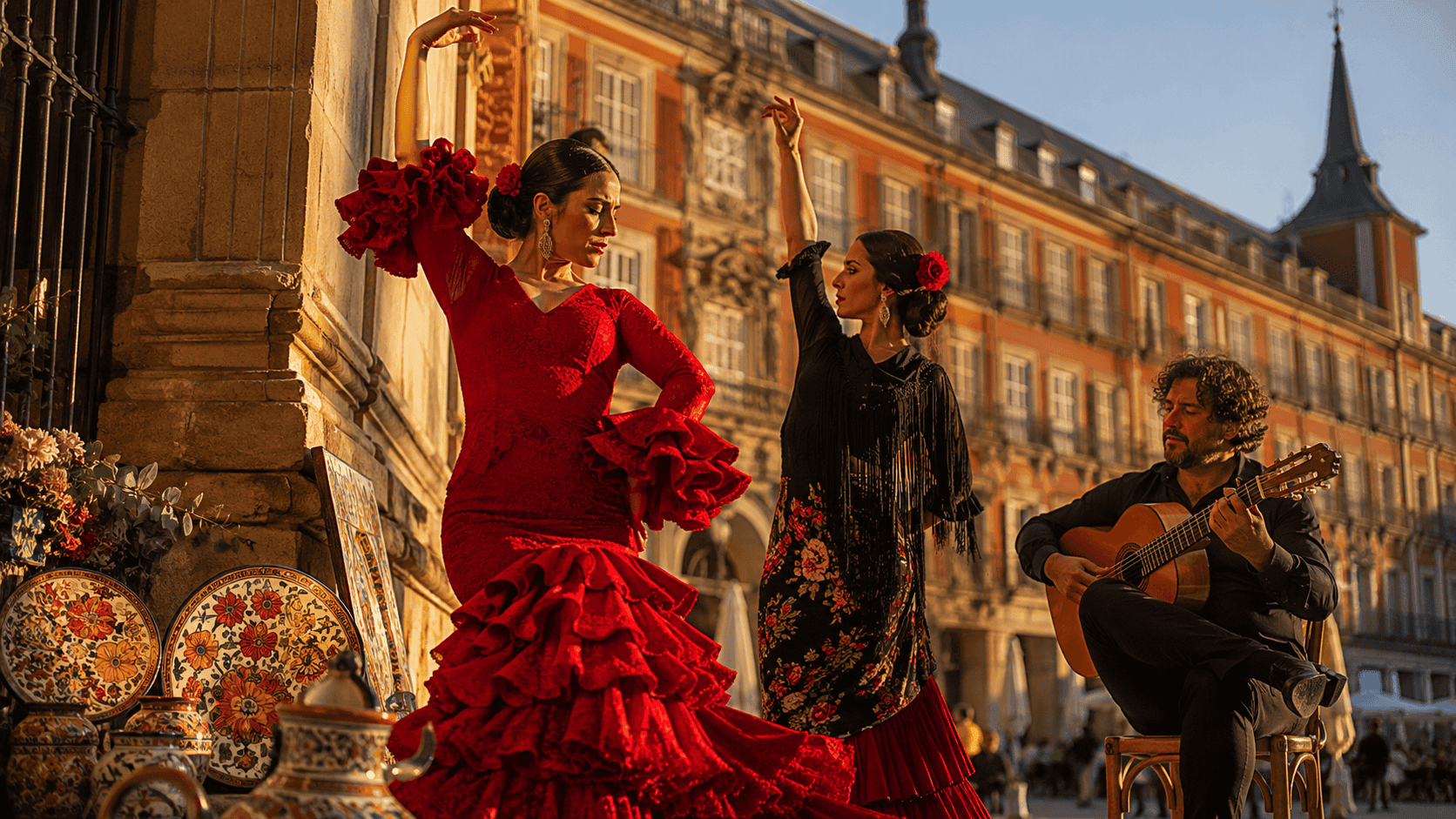
Madrid is widely recognized as the global capital of flamenco. It serves as the ultimate proving ground for dancers, guitarists, and singers. While flamenco originated in southern Spain, the historic tablaos of Madrid have hosted the most important performances in the genre’s history.
Tablao Villa Rosa and Corral de la Morería have presented legendary artists like Paco de Lucía and Camarón de la Isla. These intimate venues combine live performance with traditional dining. This creates an intense sensory experience for the audience.
The art form relies heavily on improvisation, emotional expression, and complex rhythmic footwork known as zapateado. Attending a performance in an intimate historic venue is a reliable way to Discover Madrid’s Local Culture, Traditions, Arts and Heritage.
Beyond flamenco, the city boasts a rich theatrical heritage centered around the Teatro Real. This is one of Europe’s premier opera houses. The theater, inaugurated in 1850, seats over 1,700 spectators and hosts top-tier opera and ballet productions.
The Teatro de la Zarzuela preserves Spain’s unique genre of light opera. This form combines spoken drama with traditional musical numbers.
- Teatro Real: The grand opera house located directly opposite the Royal Palace.
- Corral de la Morería: The world’s most famous flamenco tablao, featuring fine dining.
- Teatro de la Zarzuela: The historic home of Spanish lyric theater and traditional operettas.
Architectural Legacy from Hapsburgs to Bourbons
The layout of Madrid tells the story of two major royal dynasties that shaped the empire. The Hapsburg era, spanning the 16th and 17th centuries, left behind a legacy of red-brick buildings with slate spires. This style is best seen in the Plaza Mayor.
This grand square served as the stage for royal coronations, bullfights, and public trials during the Spanish Inquisition. The Bourbon dynasty arrived in the 18th century. They introduced French-influenced Baroque and Neoclassical architecture to the city.
The Royal Palace of Madrid, built with over 3,000 rooms, stands as the largest functioning royal palace in Europe. Its grand stone facade and manicured Sabatini Gardens showcase the vast ambitions of King Charles III.
The transition from the narrow, winding alleys of the Hapsburg district to the wide, grand boulevards of the Bourbon expansions represents a timeline of Spanish history. This architectural contrast allows visitors to explore the city’s rich past. You can discover it simply by walking through the city center.
Walking these streets helps travelers Discover Madrid’s Local Culture, Traditions, Arts and Heritage on foot. Every block offers a glance into a different century.
Preserving a Living Identity
Madrid is a city where history is not confined to museums. Instead, people live it daily on the streets and in public squares. By exploring historic art collections, attending traditional neighborhood festivals, and dining in centuries-old taverns, travelers can comprehend the depth of this Spanish capital.
It is easy to Discover Madrid’s Local Culture, Traditions, Arts and Heritage when you talk to the locals. Their stories keep the old ways alive.
The best way to connect with the city is to step off the beaten path. You must seek to Discover Madrid’s Local Culture, Traditions, Arts and Heritage in its everyday moments. These experiences reveal a resilient, active community that honors its past while embracing modern cultural evolution.


Comments are closed